
- Installing SureRank
- SureRank Onboarding Guide
- How to Activate Your SureRank Pro License
- SureRank Dashboard Overview
- General Settings
- Advanced Settings
- Search Console – SureRank
- Managing URL Redirection in SureRank
- SureRank Feature Management – Quick Guide
- Robots.txt Feature in SureRank
- Instant Indexing in SureRank Pro
- Using the Focus Keyword Feature in SureRank
- Using SureRank With WPML, Polylang, or TranslatePress
- How to Enable Markdown Copies in SureRank Premium
- Image SEO – SureRank
- Google Indexing in SureRank
- How to Configure Custom Fields with SureRank
- Breadcrumbs Feature in SureRank Pro
- Extended Meta Templates in SureRank Pro
- SureRank Pro – Link Suggestions
- Managing License Activations: Site Licenses, Staging, and Reusing a License
- How to Enable llms.txt in SureRank Pro
- How to Migrate from Rank Math to SureRank
- How to Migrate from Yoast to SureRank
- How to Migrate from SEOPress to SureRank SEO
- How to Migrate from Squirrly SEO to SureRank
- How to Migrate from All in One SEO (AIOSEO) to SureRank
- How to Migrate from Slim SEO to SureRank
- How to Migrate from The SEO Framework to SureRank
- Migration Failed: How to Diagnose
- After You Migrate: Verification and Cleanup Checklist
- Sitemaps in SureRank
- How to Enable Video Sitemap in SureRank Pro
- How to Enable the News Sitemap in SureRank
- How to Show the HTML Sitemap on Your Site in SureRank Pro
- How to Regenerate the Sitemap After Excluding a Post Type in SureRank
- Change the Sitemap URL in SureRank
- How to Enable Author Sitemap in SureRank
- How to Exclude Post Types from the Sitemap
- How to Enable the Author Sitemap and Why Authors Are Excluded (Pro)
- Editing Meta Box
- SureRank – Page SEO Checks
- Enabling Page SEO Checks in WordPress
- Image Alt Text – Automatic Optimization
- Link Manager
- Using the SureRank Front-End Meta Box
- How to Edit the Meta Title and Description for a Single Page or Post
- Controlling Indexing with Robot Instructions
- How to Set Global Title and Description Templates with Variables
- How to Set a Canonical URL and How the Canonical Field Works
- How to Fix WWW and Non-WWW Version Redirects to Improve Your SEO
- How to Fix: No H1 Heading Found on Your Homepage
- How to Fix Missing H2 Headings on Your Homepage
- Re-run Checks Button in SureRank
- Fix Critical Error: Another SEO Plugin Detected in SureRank
- Fix Warning: Site Tagline Is Not Set in SureRank
- How to Fix: Robots.txt Contains Invalid Rules in SureRank
- How to Fix Multiple SEO Plugins Detected on Your Site
- How to Fix: Homepage is Not Indexable by Search Engines
- Warning: Homepage Does Not Contain Internal Links
- How to Fix: Search Engine Title is Missing on the Page
- Page Level SEO: Broken Links Detected
- How to Fix Missing Alt Text on Images
- How to Fix Page URLs That Are Too Long
- Page Level SEO Warning: No Links Found on This Page
- Page Level SEO Warning: No Images or Videos Found
- Page Level SEO Warning: Missing Search Engine Description
- Page Level SEO Warning: No Subheadings Found on This Page
- Page Level SEO Warning: Canonical Tag is Missing
- Page Level SEO Warning: Open Graph Tags Missing
- What is Google Search Console and how does SureRank use it?
- Recommended Image Sizes
- SureRank – SEO Check Severity Guide
- Using SureRank with Other SEO Plugins – Best Practices
- Import/Export Feature – SureRank Plugin
- What is llms.txt and Does SureRank Support It?
- Does SureRank offer a keyword rank-tracking feature?
- Does SureRank Come With Google Analytics Integration?
- Email Summary in SureRank
- SureRank Role Manager
- Fixing a Fatal Error After Updating SureRank
- SureRank Server Requirements
- Search Engines Not Indexing Your WordPress Site?
- Sitemap Not Showing in SureRank
- Fixing robots.txt Issues in SureRank
- Why a Working Link Is Flagged as Broken (404)
- Which Pages Are Included in Your SureRank Sitemap
- Fixing False SEO Audit Warnings Caused by Caching
- Fixing “Couldn’t Fetch” for Your Sitemap in Google Search Console
- Troubleshooting: Favicon and Logo in Google Search Results (Supported Formats and CDN Gotchas)
- Customize XML Sitemap Top Bar with surerank_sitemap_top_bar_data
- Analyze ACF Field Content with SureRank
- Preserve Modified Date During Updates surerank_freeze_modified_date
- Customize Final Title Tag surerank_final_title
- Customize Post Type Archive Title Output surerank_post_type_archive_title
- Customize Archive Page Title with surerank_archive_title
- Customize the Search Results Page Title surerank_search_title
- Customizing the 404 Page Title surerank_not_found_title
- Customizing the Title Separator surerank_title_separator
- Disable SureRank’s Document Title Integration
- What Is AI Ready in SureRank?
- How to Fix the Indexing and Snippet Rules Result in SureRank AI Ready Checks
- How to Fix the Home Page Text Without JavaScript Result in SureRank AI Ready Checks
- How to Handle the OAuth Discovery Result in SureRank AI Ready Checks
- How to Handle the A2A Agent Card Result in SureRank AI Ready Checks
- How to Handle the Web Bot Auth Result in SureRank AI Ready Checks
- How to Fix the Site Slow and Site Unreachable Results in SureRank AI Ready Checks
- How to Fix the llms.txt Result in SureRank AI Ready Checks
- How to Fix the Content Signals Result in SureRank AI Ready Checks
- How to Fix the MCP Server Card Result in SureRank AI Ready Checks
Advanced Settings
Overview
The Advanced section includes Robot Instructions and Schema settings. Sitemaps are configured separately under SureRank > General > Sitemaps.
To access the Advanced Settings tab:
- Navigate to the left-side menu panel in your WordPress dashboard.
- Hover over SureRank.
- A menu will appear; click on Advanced Settings.
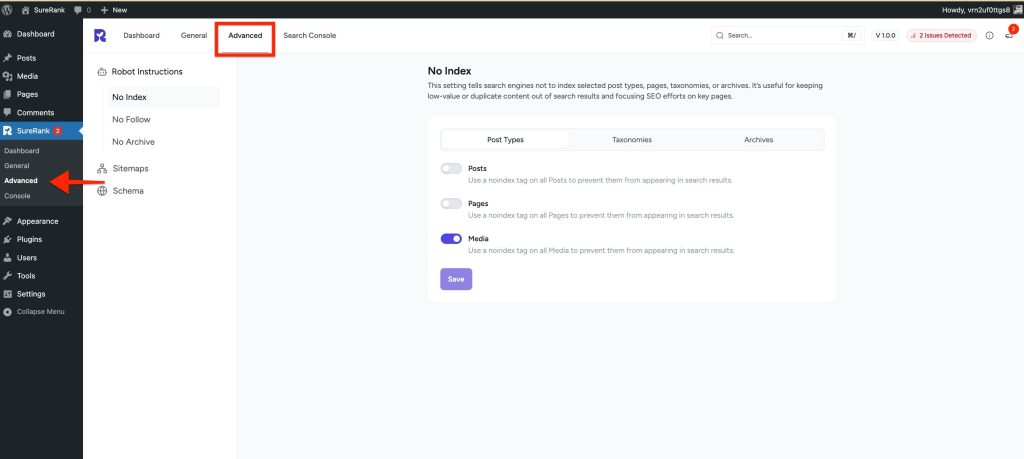
1. Robot Instructions
Under Robot Instructions, you can set rules for search engines using meta tags like noindex, nofollow, and noarchive. These controls are helpful for:
- Preventing low-value or duplicate content (e.g., media files or taxonomy pages) from being indexed.
- Use noindex for publicly accessible pages that should stay out of search results; it does not save crawl budget.
- Control search indexing separately from protecting confidential content.
What are Noindex, Nofollow, and Noarchive?
These are meta tags or robot instructions that guide search engines on how to treat specific pages on your website.
Noindex – Prevents a page from being shown in search engine results.
When to use:
- For low-value pages (like media attachment pages).
- On duplicate content (like printer-friendly versions).
- For publicly accessible pages you do not want in search results. Protect confidential content with authentication; noindex does not restrict access.
Effect: Search engines need to crawl a page to read noindex. When supported, the directive asks them to exclude that page from search results.
Nofollow asks search engines not to follow links on this page; it does not prevent discovery of their destinations elsewhere.
When to use:
- On pages with untrusted or paid links.
- Qualify links when you do not want to endorse their destinations.
- To prevent passing link authority (PageRank) to other pages.
Effect: Nofollow qualifies the links on this page. Search engines may still discover and crawl destination URLs through other links or sources.
Noarchive is a historical directive. Google Search ignores it because cached result links were removed; other services may interpret it differently.
When to use:
- For services that still honor the noarchive directive.
- Do not rely on noarchive for privacy; protect confidential content with authentication.
Effect: The directive does not restrict access or prevent third parties from saving copies.
Set robot instructions according to your goals and verify the resulting behavior. Search engines can interpret directives differently.
2. Sitemaps
Access sitemap settings at SureRank > General > Sitemaps. SureRank can generate XML sitemaps to help search engines discover eligible content.
Learn more about Sitemaps in SureRank: Sitemaps Documentation.
3. Schema
Schema markup helps search engines understand your content better and display rich results in search. SureRank allows you to configure Schema types for different content like articles, products, FAQs, and more, directly from your WordPress dashboard.
Learn how to configure Schema in SureRank: Schema Setup Documentation.
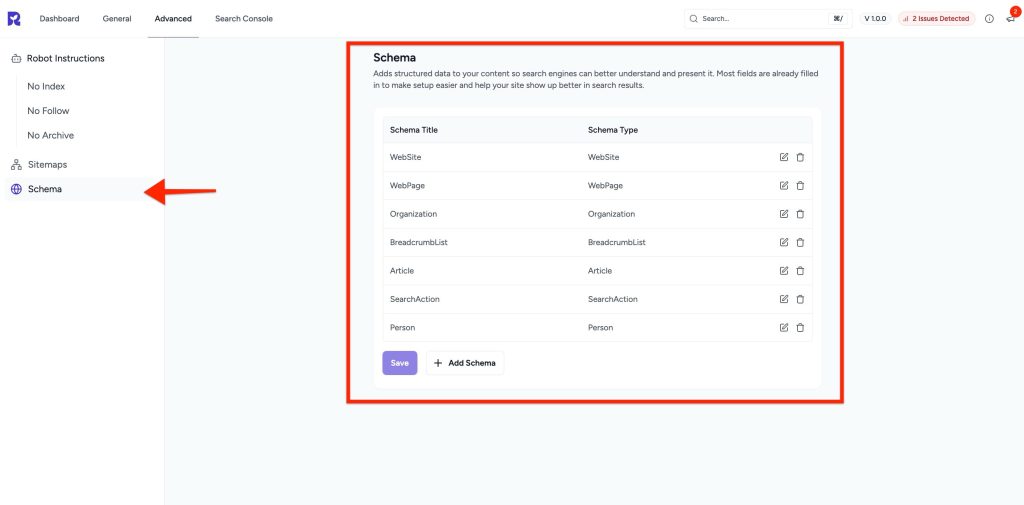
Make sure to review these settings under the Advanced tab to ensure your site’s SEO is aligned with your goals and optimized for search engine visibility.
We don't respond to the article feedback, we use it to improve our support content.