
- Installing SureRank
- SureRank Onboarding Guide
- How to Activate Your SureRank Pro License
- SureRank Dashboard Overview
- General Settings
- Advanced Settings
- Search Console – SureRank
- Managing URL Redirection in SureRank
- SureRank Feature Management – Quick Guide
- Robots.txt Feature in SureRank
- Instant Indexing in SureRank Pro
- Using the Focus Keyword Feature in SureRank
- Using SureRank With WPML, Polylang, or TranslatePress
- How to Enable Markdown Copies in SureRank Premium
- Image SEO – SureRank
- Google Indexing in SureRank
- How to Configure Custom Fields with SureRank
- Breadcrumbs Feature in SureRank Pro
- Extended Meta Templates in SureRank Pro
- SureRank Pro – Link Suggestions
- Managing License Activations: Site Licenses, Staging, and Reusing a License
- How to Enable llms.txt in SureRank Pro
- How to Migrate from Rank Math to SureRank
- How to Migrate from Yoast to SureRank
- How to Migrate from SEOPress to SureRank SEO
- How to Migrate from Squirrly SEO to SureRank
- How to Migrate from All in One SEO (AIOSEO) to SureRank
- How to Migrate from Slim SEO to SureRank
- How to Migrate from The SEO Framework to SureRank
- Migration Failed: How to Diagnose
- After You Migrate: Verification and Cleanup Checklist
- Sitemaps in SureRank
- How to Enable Video Sitemap in SureRank Pro
- How to Enable the News Sitemap in SureRank
- How to Show the HTML Sitemap on Your Site in SureRank Pro
- How to Regenerate the Sitemap After Excluding a Post Type in SureRank
- Change the Sitemap URL in SureRank
- How to Enable Author Sitemap in SureRank
- How to Exclude Post Types from the Sitemap
- How to Enable the Author Sitemap and Why Authors Are Excluded (Pro)
- Editing Meta Box
- SureRank – Page SEO Checks
- Enabling Page SEO Checks in WordPress
- Image Alt Text – Automatic Optimization
- Link Manager
- Using the SureRank Front-End Meta Box
- How to Edit the Meta Title and Description for a Single Page or Post
- Controlling Indexing with Robot Instructions
- How to Set Global Title and Description Templates with Variables
- How to Set a Canonical URL and How the Canonical Field Works
- How to Fix WWW and Non-WWW Version Redirects to Improve Your SEO
- How to Fix: No H1 Heading Found on Your Homepage
- How to Fix Missing H2 Headings on Your Homepage
- Re-run Checks Button in SureRank
- Fix Critical Error: Another SEO Plugin Detected in SureRank
- Fix Warning: Site Tagline Is Not Set in SureRank
- How to Fix: Robots.txt Contains Invalid Rules in SureRank
- How to Fix Multiple SEO Plugins Detected on Your Site
- How to Fix: Homepage is Not Indexable by Search Engines
- Warning: Homepage Does Not Contain Internal Links
- How to Fix: Search Engine Title is Missing on the Page
- Page Level SEO: Broken Links Detected
- How to Fix Missing Alt Text on Images
- How to Fix Page URLs That Are Too Long
- Page Level SEO Warning: No Links Found on This Page
- Page Level SEO Warning: No Images or Videos Found
- Page Level SEO Warning: Missing Search Engine Description
- Page Level SEO Warning: No Subheadings Found on This Page
- Page Level SEO Warning: Canonical Tag is Missing
- Page Level SEO Warning: Open Graph Tags Missing
- What is Google Search Console and how does SureRank use it?
- Recommended Image Sizes
- SureRank – SEO Check Severity Guide
- Using SureRank with Other SEO Plugins – Best Practices
- Import/Export Feature – SureRank Plugin
- What is llms.txt and Does SureRank Support It?
- Does SureRank offer a keyword rank-tracking feature?
- Does SureRank Come With Google Analytics Integration?
- Email Summary in SureRank
- SureRank Role Manager
- Fixing a Fatal Error After Updating SureRank
- SureRank Server Requirements
- Search Engines Not Indexing Your WordPress Site?
- Sitemap Not Showing in SureRank
- Fixing robots.txt Issues in SureRank
- Why a Working Link Is Flagged as Broken (404)
- Which Pages Are Included in Your SureRank Sitemap
- Fixing False SEO Audit Warnings Caused by Caching
- Fixing “Couldn’t Fetch” for Your Sitemap in Google Search Console
- Troubleshooting: Favicon and Logo in Google Search Results (Supported Formats and CDN Gotchas)
- Customize XML Sitemap Top Bar with surerank_sitemap_top_bar_data
- Analyze ACF Field Content with SureRank
- Preserve Modified Date During Updates surerank_freeze_modified_date
- Customize Final Title Tag surerank_final_title
- Customize Post Type Archive Title Output surerank_post_type_archive_title
- Customize Archive Page Title with surerank_archive_title
- Customize the Search Results Page Title surerank_search_title
- Customizing the 404 Page Title surerank_not_found_title
- Customizing the Title Separator surerank_title_separator
- Disable SureRank’s Document Title Integration
- What Is AI Ready in SureRank?
- How to Fix the Indexing and Snippet Rules Result in SureRank AI Ready Checks
- How to Fix the Home Page Text Without JavaScript Result in SureRank AI Ready Checks
- How to Handle the OAuth Discovery Result in SureRank AI Ready Checks
- How to Handle the A2A Agent Card Result in SureRank AI Ready Checks
- How to Handle the Web Bot Auth Result in SureRank AI Ready Checks
- How to Fix the Site Slow and Site Unreachable Results in SureRank AI Ready Checks
- How to Fix the llms.txt Result in SureRank AI Ready Checks
- How to Fix the Content Signals Result in SureRank AI Ready Checks
- How to Fix the MCP Server Card Result in SureRank AI Ready Checks
General Settings
Overview
Use General Settings to set default SEO metadata for your site. These defaults help your pages appear correctly in search results, even if you don’t add custom SEO to individual posts or pages. You can override these defaults on any post or page.
Accessing General Settings
- Open your WordPress dashboard.
- In the left menu, hover over “SureRank.”
- Click “General Settings.”
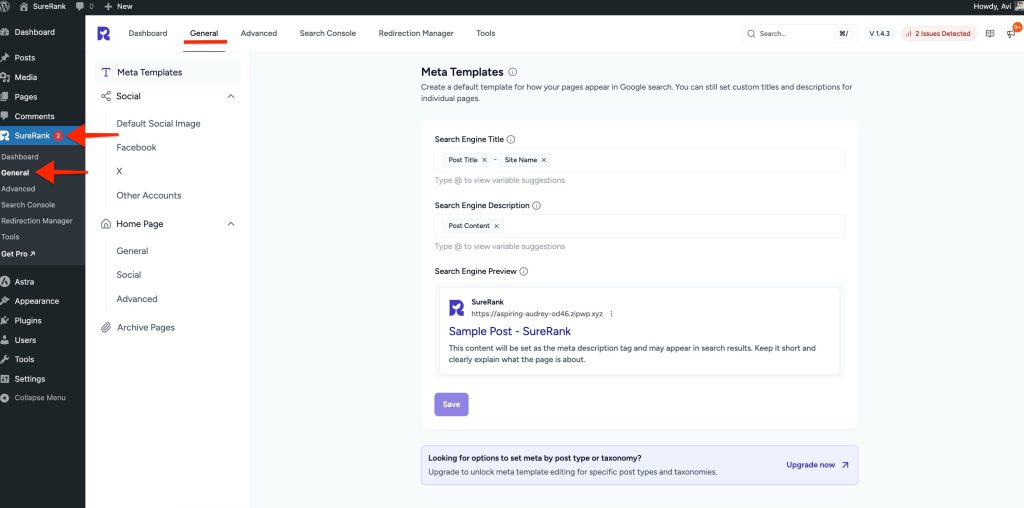
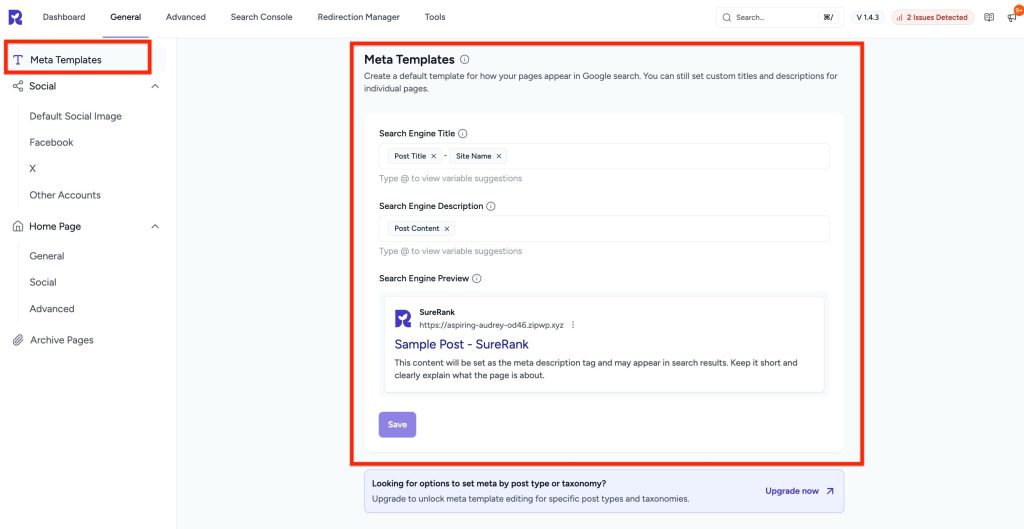
Meta Templates
Set how your pages appear in search results. You can use dynamic variables (such as Post Title, Site Name, and Post Content) to keep titles and descriptions consistent across your site.
- Search Engine Title
- Type @ to insert variables.
- Write a concise, descriptive title. Around 50–60 characters can be a drafting guide, but search engines may truncate or rewrite it.
- Search Engine Description
- Type @ to insert variables.
- Write a useful page-specific summary. Around 140–160 characters can be a drafting guide, but search engines may truncate or rewrite it.
- Search Engine Preview: See an example of how your page may appear in search results. The preview is an approximation and may differ slightly on search engines.
Tips for Writing Effective Titles and Descriptions:
Title:
- Include the main keyword (preferably at the start).
- Use roughly 50–60 characters as a drafting guide, not a fixed limit.
- Make it relevant and engaging.
Description:
- Include secondary keywords.
- Use roughly 140–160 characters as a drafting guide, not a fixed limit.
- Make it compelling and clear.
Example:
Service: SEO Consulting Services
SEO Title: Expert SEO Consulting Services for Higher Rankings | RankBetter
Meta Description: Drive more traffic with custom SEO strategies tailored to your business. Work with an experienced SEO consultant and get real results.
Course: Learn SEO in 30 Days
SEO Title: Learn SEO in 30 Days – Beginner to Pro | Free Online Course
Meta Description: Master SEO basics and advanced techniques in just 30 days. Join our free course and start ranking your website on Google faster!
Social Settings
Control how your content looks when shared on social platforms.
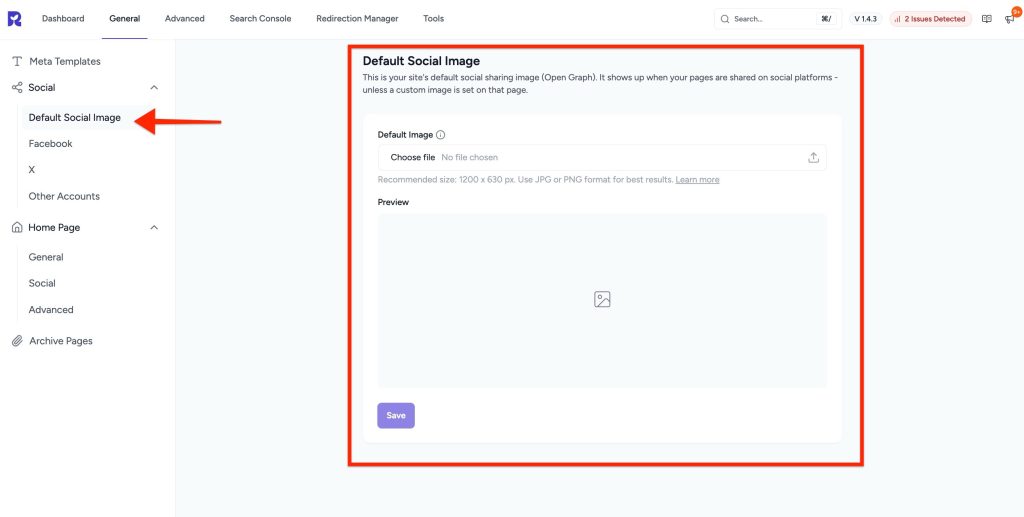
Default Social Image
The Default Social Image refers to the image that is automatically used when a page or post on your website is shared on social media platforms (such as Facebook, Twitter, LinkedIn), if that specific page does not have a dedicated image set.
Why It’s Important for SEO and Social Sharing:
- Visual Appeal: Posts with images get more clicks and engagement.
- Branding: A consistent default image helps represent your brand.
- Fallback: Ensures your content doesn’t appear with a blank or broken image when shared.
- Facebook Preview – Shows a preview of how your page will look when shared.
- Facebook Page – Enter your Facebook page URL.
- Author Facebook Page – Set a fallback URL for the author’s Facebook page.
Adding these URLs enhances the richness of social metadata (Open Graph tags), improving how your links appear when shared, which can boost click-through rates and user trust.
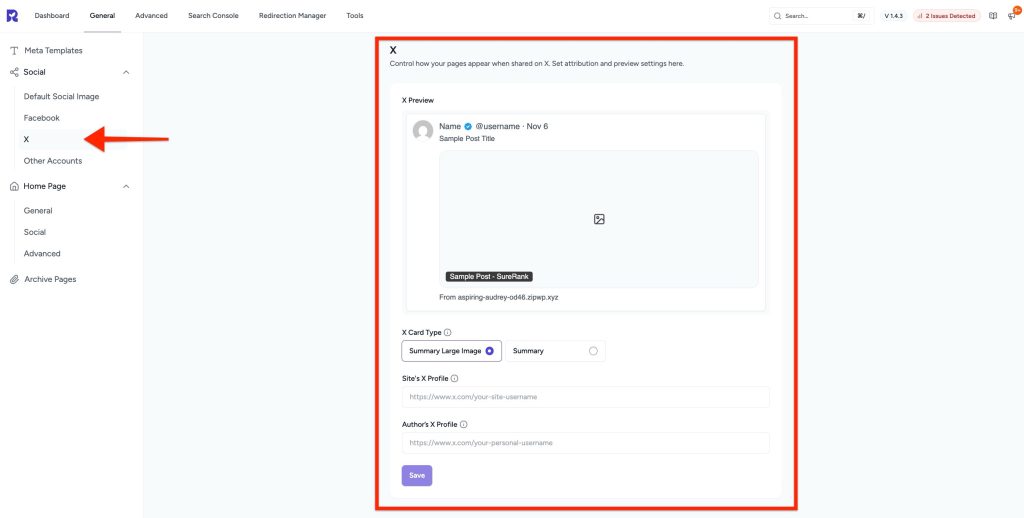
X (Twitter)
- X Preview – Displays a preview of your post on X.
- X Card Type – Choose between:
- Summary Large Image
- Summary
- Site’s X Profile – Add your profile URL.
- Author’s X Profile – Set the author’s profile URL.
These fields use Twitter Cards markup, which improves how your links look on X and can enhance engagement.
Other Accounts
List of social profiles you can add:
- YouTube
- TikTok
- Telegram
- Yelp
- BlueSky
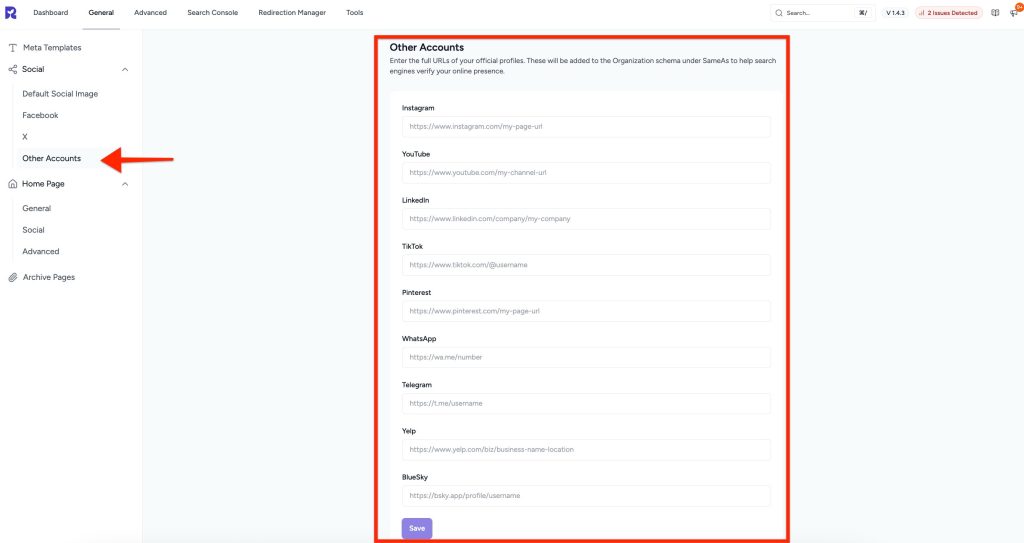
Other Accounts and Structured Data
Add official social profile URLs to help identify your organization or person in structured data. These fields do not guarantee rankings, a Knowledge Panel, traffic, or profiles appearing in search results.
- Use official profile URLs to identify your brand across platforms.
- Help search engines associate the profiles with your organization or person.
- Provide identity information that search engines may use.
- Profile links do not guarantee referral traffic.
- Include official profile URLs in the sameAs property of structured data.
- Use consistent official profiles across platforms.
- Search engines decide whether to show social profiles in results.
Home Settings
The Home section contains three subsections: General, Social, and Advanced.
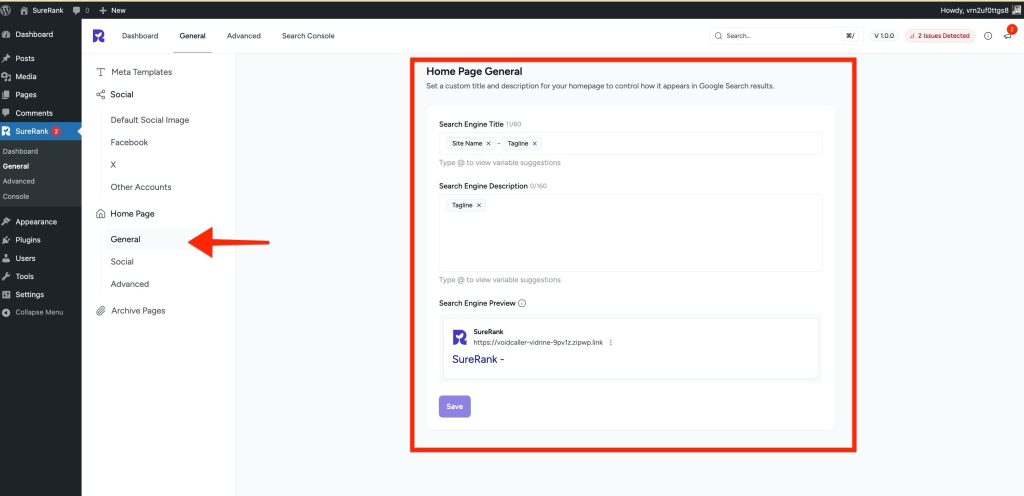
Home Page General
- Search Engine Title – Type @ to view variable suggestions.
- Search Engine Description – Input a custom meta description.
- Search Engine Preview – Displays a preview of how your homepage appears in search results.
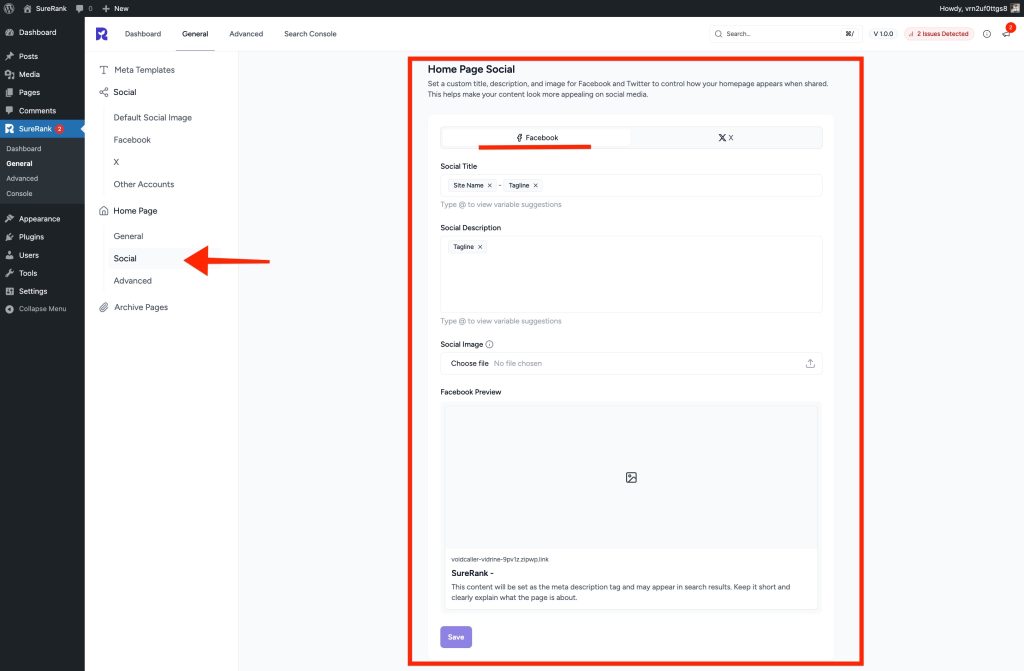
Home Page Social
There are two tabs: Facebook and X (Twitter).
- Social Title – Type @ to view variable suggestions.
- Social Description – Type @ to view variable suggestions.
- Social Fallback Image – Upload an image.
- Facebook Preview – Displays how the page will appear when shared on Facebook.
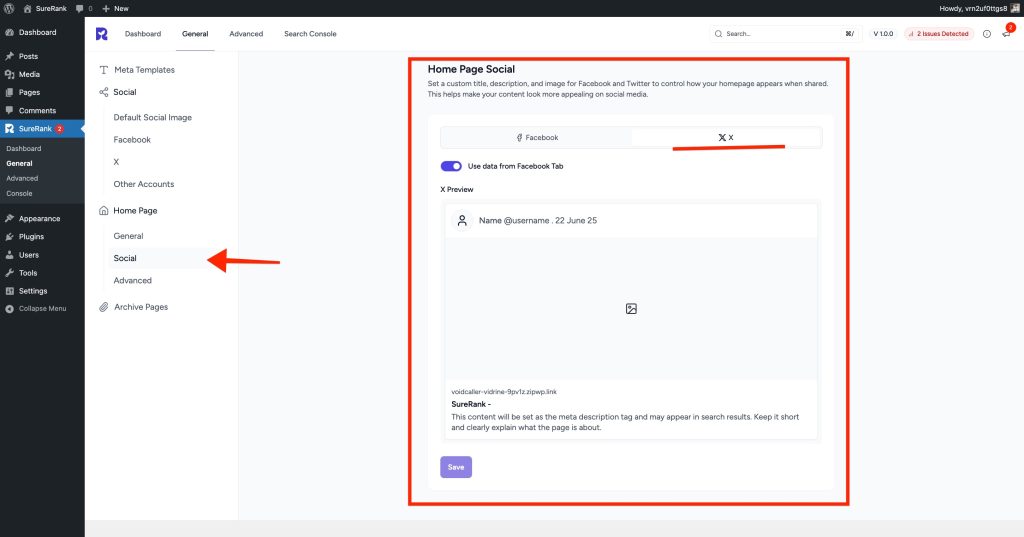
X (Twitter)
- Toggle option to Use data from Facebook Tab.
- Social Title – Type @ to view variable suggestions.
- Social Description – Type @ to view variable suggestions.
- Social Fallback Image – Upload an image.
- X Preview – Displays a preview of how the page will appear when shared on X.
Advanced Settings
Robot Instructions
These settings add robot directives for your homepage. Search engines must be able to crawl the page to read them, and directives do not restrict access.
- No Index – Prevents search engines from indexing this page.
- No Follow – Prevents search engines from following links on this page.
- No Archive outputs a historical directive. Google Search ignores noarchive because cached result links were removed; other services may interpret it differently.
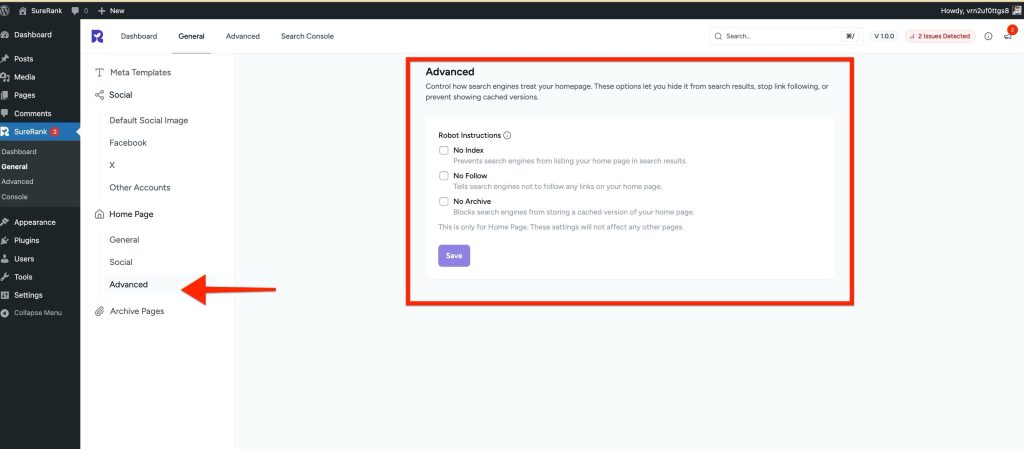
This is only for the Home Page. These settings will not affect any other pages.
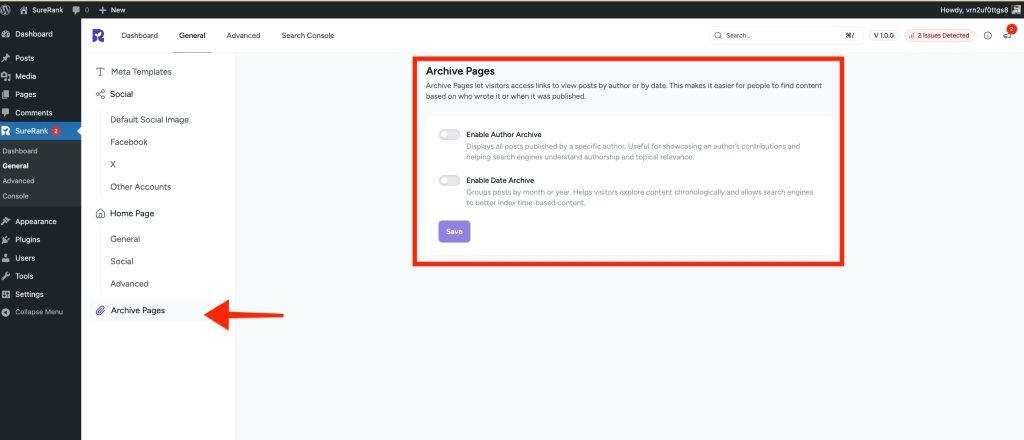
Archive Pages
Archive Pages allow visitors to browse posts organized by author or publication date, making it easier to find content based on who created it or when it was published.
- Enable Author Archive – Displays a list of all posts written by a specific author. This is useful for highlighting an author’s contributions and improving search engine understanding of authorship and content relevance.
- Enable Date Archive – Organizes posts by month or year, enabling visitors to explore content chronologically. It also helps search engines index time-based content more effectively.
We don't respond to the article feedback, we use it to improve our support content.