
- Installing SureRank
- SureRank Onboarding Guide
- How to Activate Your SureRank Pro License
- SureRank Dashboard Overview
- General Settings
- Advanced Settings
- Search Console – SureRank
- Managing URL Redirection in SureRank
- SureRank Feature Management – Quick Guide
- Robots.txt Feature in SureRank
- Instant Indexing in SureRank Pro
- Using the Focus Keyword Feature in SureRank
- Using SureRank With WPML, Polylang, or TranslatePress
- How to Enable Markdown Copies in SureRank Premium
- Image SEO – SureRank
- Google Indexing in SureRank
- How to Configure Custom Fields with SureRank
- Breadcrumbs Feature in SureRank Pro
- Extended Meta Templates in SureRank Pro
- SureRank Pro – Link Suggestions
- Managing License Activations: Site Licenses, Staging, and Reusing a License
- How to Enable llms.txt in SureRank Pro
- How to Migrate from Rank Math to SureRank
- How to Migrate from Yoast to SureRank
- How to Migrate from SEOPress to SureRank SEO
- How to Migrate from Squirrly SEO to SureRank
- How to Migrate from All in One SEO (AIOSEO) to SureRank
- How to Migrate from Slim SEO to SureRank
- How to Migrate from The SEO Framework to SureRank
- Migration Failed: How to Diagnose
- After You Migrate: Verification and Cleanup Checklist
- Sitemaps in SureRank
- How to Enable Video Sitemap in SureRank Pro
- How to Enable the News Sitemap in SureRank
- How to Show the HTML Sitemap on Your Site in SureRank Pro
- How to Regenerate the Sitemap After Excluding a Post Type in SureRank
- Change the Sitemap URL in SureRank
- How to Enable Author Sitemap in SureRank
- How to Exclude Post Types from the Sitemap
- How to Enable the Author Sitemap and Why Authors Are Excluded (Pro)
- Editing Meta Box
- SureRank – Page SEO Checks
- Enabling Page SEO Checks in WordPress
- Image Alt Text – Automatic Optimization
- Link Manager
- Using the SureRank Front-End Meta Box
- How to Edit the Meta Title and Description for a Single Page or Post
- Controlling Indexing with Robot Instructions
- How to Set Global Title and Description Templates with Variables
- How to Set a Canonical URL and How the Canonical Field Works
- How to Fix WWW and Non-WWW Version Redirects to Improve Your SEO
- How to Fix: No H1 Heading Found on Your Homepage
- How to Fix Missing H2 Headings on Your Homepage
- Re-run Checks Button in SureRank
- Fix Critical Error: Another SEO Plugin Detected in SureRank
- Fix Warning: Site Tagline Is Not Set in SureRank
- How to Fix: Robots.txt Contains Invalid Rules in SureRank
- How to Fix Multiple SEO Plugins Detected on Your Site
- How to Fix: Homepage is Not Indexable by Search Engines
- Warning: Homepage Does Not Contain Internal Links
- How to Fix: Search Engine Title is Missing on the Page
- Page Level SEO: Broken Links Detected
- How to Fix Missing Alt Text on Images
- How to Fix Page URLs That Are Too Long
- Page Level SEO Warning: No Links Found on This Page
- Page Level SEO Warning: No Images or Videos Found
- Page Level SEO Warning: Missing Search Engine Description
- Page Level SEO Warning: No Subheadings Found on This Page
- Page Level SEO Warning: Canonical Tag is Missing
- Page Level SEO Warning: Open Graph Tags Missing
- What is Google Search Console and how does SureRank use it?
- Recommended Image Sizes
- SureRank – SEO Check Severity Guide
- Using SureRank with Other SEO Plugins – Best Practices
- Import/Export Feature – SureRank Plugin
- What is llms.txt and Does SureRank Support It?
- Does SureRank offer a keyword rank-tracking feature?
- Does SureRank Come With Google Analytics Integration?
- Email Summary in SureRank
- SureRank Role Manager
- Fixing a Fatal Error After Updating SureRank
- SureRank Server Requirements
- Search Engines Not Indexing Your WordPress Site?
- Sitemap Not Showing in SureRank
- Fixing robots.txt Issues in SureRank
- Why a Working Link Is Flagged as Broken (404)
- Which Pages Are Included in Your SureRank Sitemap
- Fixing False SEO Audit Warnings Caused by Caching
- Fixing “Couldn’t Fetch” for Your Sitemap in Google Search Console
- Troubleshooting: Favicon and Logo in Google Search Results (Supported Formats and CDN Gotchas)
- Customize XML Sitemap Top Bar with surerank_sitemap_top_bar_data
- Analyze ACF Field Content with SureRank
- Preserve Modified Date During Updates surerank_freeze_modified_date
- Customize Final Title Tag surerank_final_title
- Customize Post Type Archive Title Output surerank_post_type_archive_title
- Customize Archive Page Title with surerank_archive_title
- Customize the Search Results Page Title surerank_search_title
- Customizing the 404 Page Title surerank_not_found_title
- Customizing the Title Separator surerank_title_separator
- Disable SureRank’s Document Title Integration
- What Is AI Ready in SureRank?
- How to Fix the Indexing and Snippet Rules Result in SureRank AI Ready Checks
- How to Fix the Home Page Text Without JavaScript Result in SureRank AI Ready Checks
- How to Handle the OAuth Discovery Result in SureRank AI Ready Checks
- How to Handle the A2A Agent Card Result in SureRank AI Ready Checks
- How to Handle the Web Bot Auth Result in SureRank AI Ready Checks
- How to Fix the Site Slow and Site Unreachable Results in SureRank AI Ready Checks
- How to Fix the llms.txt Result in SureRank AI Ready Checks
- How to Fix the Content Signals Result in SureRank AI Ready Checks
- How to Fix the MCP Server Card Result in SureRank AI Ready Checks
Managing URL Redirection in SureRank
The Link Manager feature in SureRank Pro allows you to manage 301 redirections for your WordPress website with ease.
What is a 301 Redirect Manager in SureRank?
The 301 Redirect Manager in the SureRank SEO plugin for WordPress allows you to permanently redirect one URL to another. This helps ensure that both visitors and search engines are automatically sent to the correct page when a URL is changed, deleted, or no longer exists.
What Does the SureRank 301 Redirect Manager Do?
- Redirects Old URLs to New Ones
If you update or remove a page, SureRank lets you easily create a 301 redirect so users land on the right page. - Preserves SEO Value
A permanent redirect signals that content has moved to a new URL and helps search engines consolidate signals. Rankings may fluctuate while the move is processed. - Prevents 404 Errors
Redirects help avoid broken links (404 errors), which can hurt user experience and your site’s SEO. - Fixes Duplicate URLs
Redirects multiple versions of the same page (e.g., with or without “www” or trailing slashes) to a single, clean URL. - Supports Site Changes
Whether you’re restructuring URLs, changing domains, or redesigning your site, SureRank’s redirect manager helps keep everything SEO-friendly.
Why Use SureRank’s 301 Redirect Manager?
Without proper redirects, updated or deleted pages can cause:
- Lost traffic
- Lower SEO rankings
- A poor user experience
SureRank makes it easy to manage redirects, no need to touch your .htaccess file or write any code.
Accessing the Link Manager
Once both plugins are installed, follow these steps:
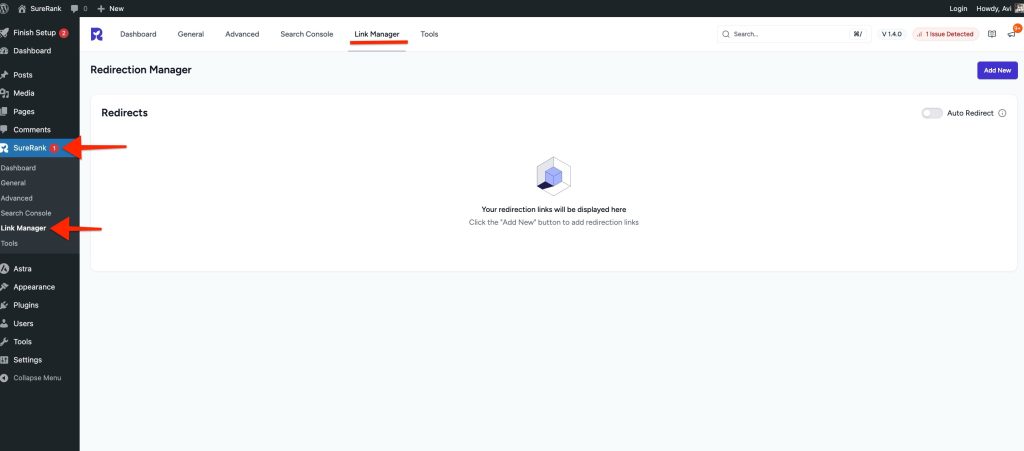
- Go to your WordPress dashboard.
- Navigate to SureRank → Link Manager.
Enable Auto Redirect
The Auto Redirect feature in the Link Manager automatically redirects visitors to the updated URL whenever you make changes to a post, page, or custom post type (CPT). This ensures that old URLs don’t break and visitors are always sent to the correct, updated link.
For example, if you update the slug of a blog post, the old link will automatically redirect to the new one without needing to create a manual redirect rule.
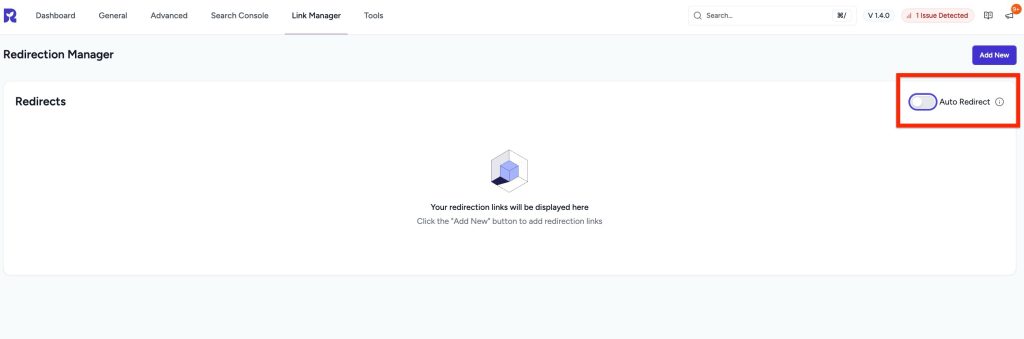
Simply switch the toggle ON. Once enabled, any changes to post, page, or CPT URLs will automatically create redirects to the new link.
Adding a New Redirection
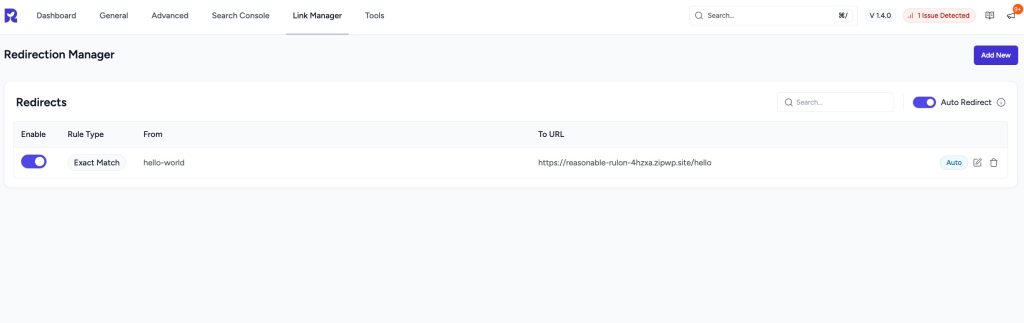
Click the Add New button to create a new redirection.
A slide-in panel will appear on the right side, where you can configure the following:
1. From URL
- Enter the original URL (the one you want to redirect from).
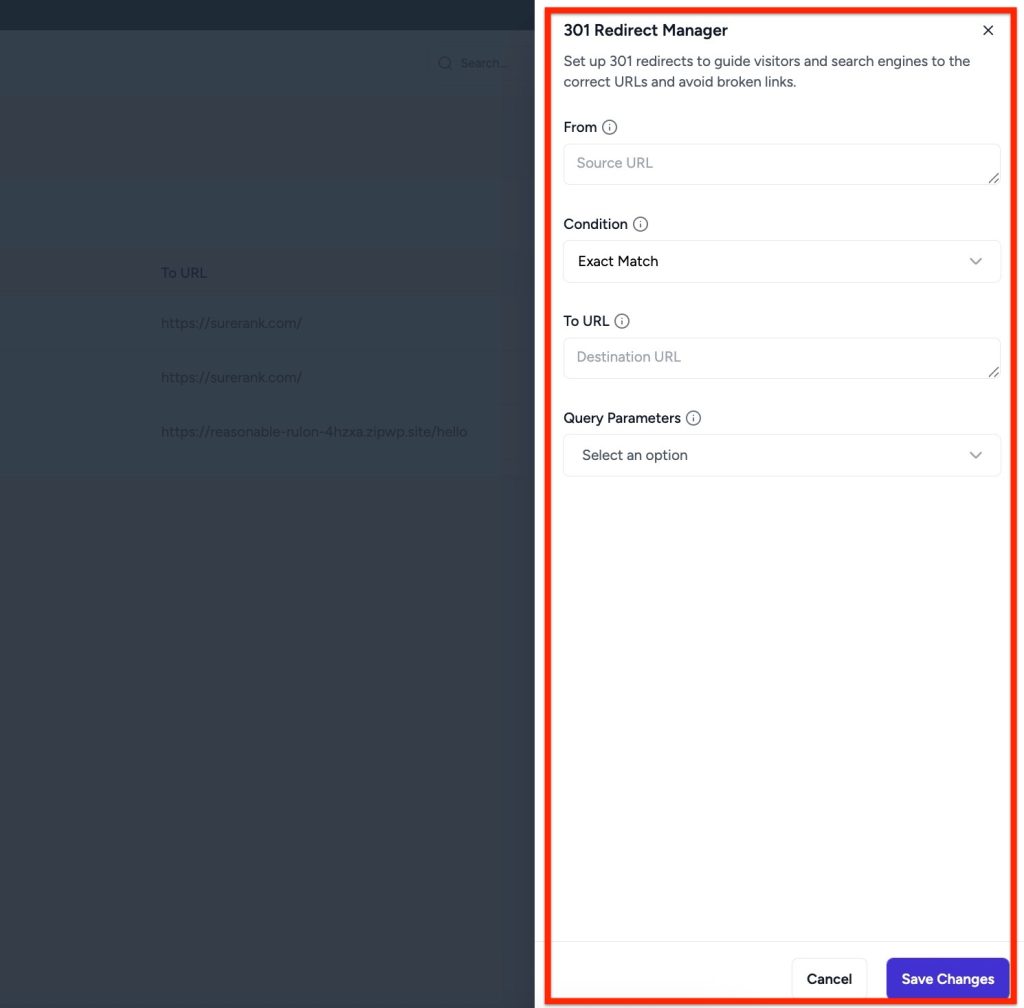
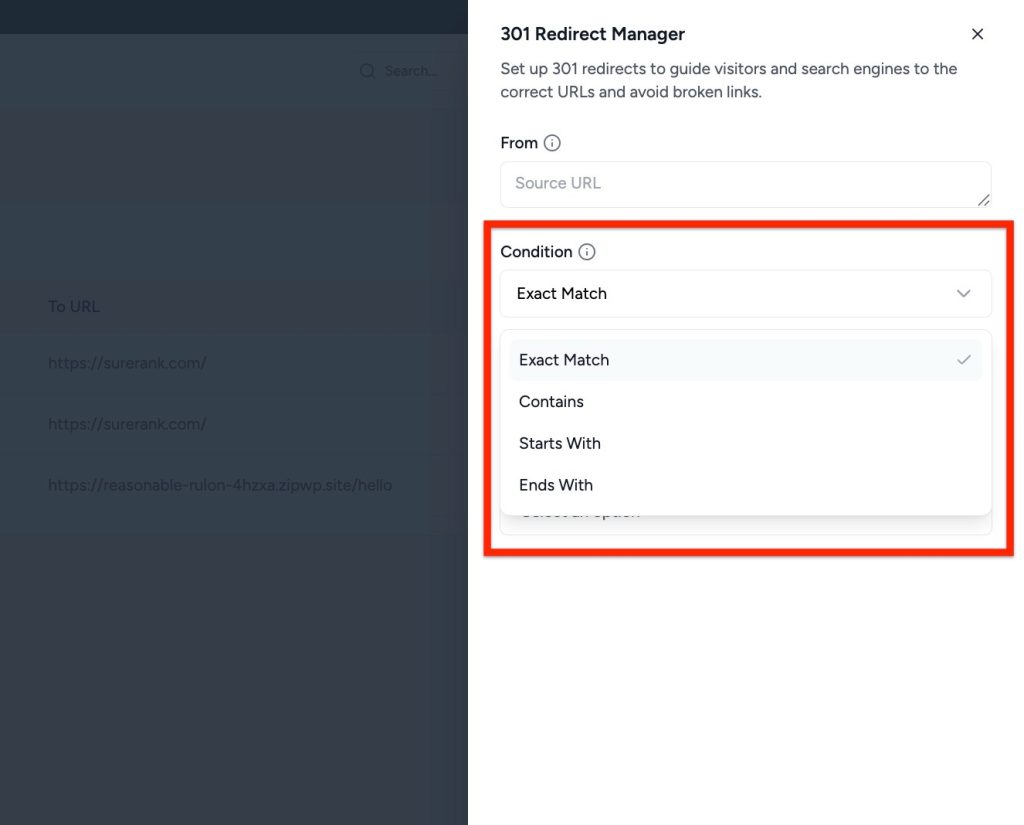
2. Condition
- Choose how the redirection should be applied:
- Exact Match: /old matches /old only.
- Contains: /old matches /news/old-story.
- Starts With: /old matches /old/page.
- Ends With: /old matches /news/old.
3. To URL
- Enter the destination URL where you want the user to be redirected.
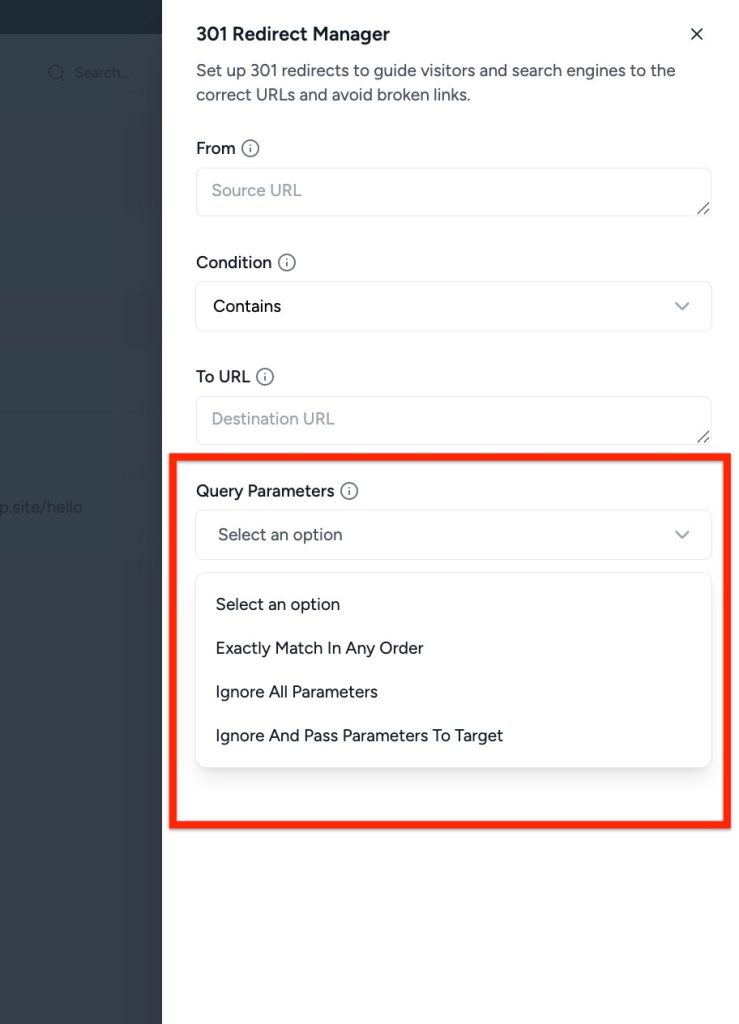
4. Query Parameters
- Choose how to handle query parameters in the URL:
- Exact Match In Any Order: /old?a=1&b=2 matches /old?b=2&a=1.
- Ignore All Parameters: /old?a=1 can match /old?a=2; incoming parameters are not passed to the target.
- Ignore and Pass Parameters to Target: /old?ref=a can match and pass ref=a to the destination.
After saving, test the source URL, an unrelated URL, and a URL with query parameters. Confirm one 301 response reaches the intended 200 destination without a loop.
Redirection Management Options
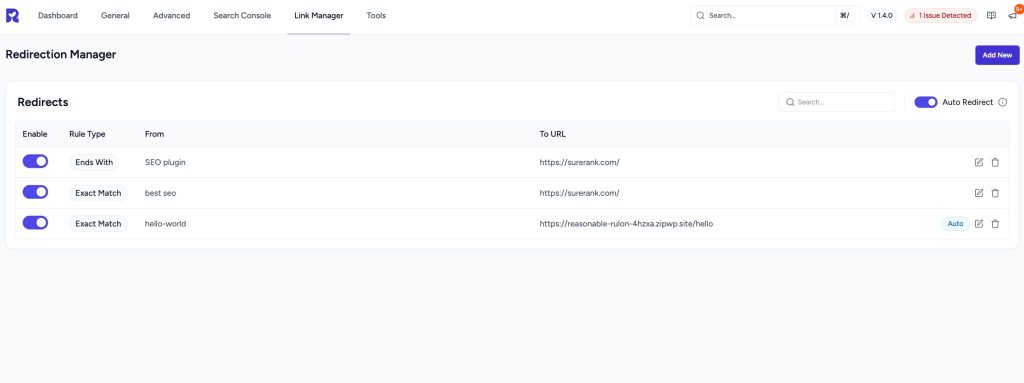
Once added, each redirection entry includes:
- Enable/Disable Toggle
- Search bar to find specific redirects
- Edit option to modify existing redirects
- Delete option to remove redirects
That’s it! You’ve successfully added and managed a redirection using the Link Manager in SureRank Pro.
We don't respond to the article feedback, we use it to improve our support content.