
- How to Migrate from Rank Math to SureRank
- How to Migrate from Yoast to SureRank
- How to Migrate from SEOPress to SureRank SEO
- How to Migrate from Squirrly SEO to SureRank
- How to Migrate from All in One SEO (AIOSEO) to SureRank
- How to Migrate from Slim SEO to SureRank
- How to Migrate from The SEO Framework to SureRank
- Migration Failed: How to Diagnose
- After You Migrate: Verification and Cleanup Checklist
- Sitemaps in SureRank
- How to Enable Video Sitemap in SureRank Pro
- How to Enable the News Sitemap in SureRank
- How to Show the HTML Sitemap on Your Site in SureRank Pro
- How to Regenerate the Sitemap After Excluding a Post Type in SureRank
- Change the Sitemap URL in SureRank
- How to Enable Author Sitemap in SureRank
- How to Exclude Post Types from the Sitemap
- How to Enable the Author Sitemap and Why Authors Are Excluded (Pro)
- Editing Meta Box
- SureRank – Page SEO Checks
- Enabling Page SEO Checks in WordPress
- Image Alt Text – Automatic Optimization
- Link Manager
- Using the SureRank Front-End Meta Box
- How to Edit the Meta Title and Description for a Single Page or Post
- Controlling Indexing with Robot Instructions
- How to Set Global Title and Description Templates with Variables
- How to Set a Canonical URL and How the Canonical Field Works
- How to Fix WWW and Non-WWW Version Redirects to Improve Your SEO
- How to Fix: No H1 Heading Found on Your Homepage
- How to Fix Missing H2 Headings on Your Homepage
- Re-run Checks Button in SureRank
- Fix Critical Error: Another SEO Plugin Detected in SureRank
- Fix Warning: Site Tagline Is Not Set in SureRank
- How to Fix: Robots.txt Contains Invalid Rules in SureRank
- How to Fix Multiple SEO Plugins Detected on Your Site
- How to Fix: Homepage is Not Indexable by Search Engines
- Warning: Homepage Does Not Contain Internal Links
- How to Fix: Search Engine Title is Missing on the Page
- Page Level SEO: Broken Links Detected
- How to Fix Missing Alt Text on Images
- How to Fix Page URLs That Are Too Long
- Page Level SEO Warning: No Links Found on This Page
- Page Level SEO Warning: No Images or Videos Found
- Page Level SEO Warning: Missing Search Engine Description
- Page Level SEO Warning: No Subheadings Found on This Page
- Page Level SEO Warning: Canonical Tag is Missing
- Page Level SEO Warning: Open Graph Tags Missing
- What is Google Search Console and how does SureRank use it?
- Recommended Image Sizes
- SureRank – SEO Check Severity Guide
- Using SureRank with Other SEO Plugins – Best Practices
- Import/Export Feature – SureRank Plugin
- What is llms.txt and Does SureRank Support It?
- Does SureRank offer a keyword rank-tracking feature?
- Does SureRank Come With Google Analytics Integration?
- Email Summary in SureRank
- SureRank Role Manager
- Fixing a Fatal Error After Updating SureRank
- SureRank Server Requirements
- Search Engines Not Indexing Your WordPress Site?
- Sitemap Not Showing in SureRank
- Fixing robots.txt Issues in SureRank
- Why a Working Link Is Flagged as Broken (404)
- Which Pages Are Included in Your SureRank Sitemap
- Fixing False SEO Audit Warnings Caused by Caching
- Fixing “Couldn’t Fetch” for Your Sitemap in Google Search Console
- Troubleshooting: Favicon and Logo in Google Search Results (Supported Formats and CDN Gotchas)
- Customize XML Sitemap Top Bar with surerank_sitemap_top_bar_data
- Analyze ACF Field Content with SureRank
- Preserve Modified Date During Updates surerank_freeze_modified_date
- Customize Final Title Tag surerank_final_title
- Customize Post Type Archive Title Output surerank_post_type_archive_title
- Customize Archive Page Title with surerank_archive_title
- Customize the Search Results Page Title surerank_search_title
- Customizing the 404 Page Title surerank_not_found_title
- Customizing the Title Separator surerank_title_separator
- Disable SureRank’s Document Title Integration
- What Is AI Ready in SureRank?
- How to Fix the Indexing and Snippet Rules Result in SureRank AI Ready Checks
- How to Fix the Home Page Text Without JavaScript Result in SureRank AI Ready Checks
- How to Handle the OAuth Discovery Result in SureRank AI Ready Checks
- How to Handle the A2A Agent Card Result in SureRank AI Ready Checks
- How to Handle the Web Bot Auth Result in SureRank AI Ready Checks
- How to Fix the Site Slow and Site Unreachable Results in SureRank AI Ready Checks
- How to Fix the llms.txt Result in SureRank AI Ready Checks
- How to Fix the Content Signals Result in SureRank AI Ready Checks
- How to Fix the MCP Server Card Result in SureRank AI Ready Checks
- How to Fix the Agent Skills Index Result in SureRank AI Ready Checks
- How to Fix the auth.md Result in SureRank AI Ready Checks
- How to Fix the AI Catalog Result in SureRank AI Ready Checks
- How to Fix the Personal Agent Protocol Result in SureRank AI Ready Checks
- What Each AI Ready Check Means in SureRank
- How to Run AI Ready Checks and Fix the Results in SureRank
- How to Set Content Signals in SureRank
- How to Publish Agent Discovery Files in SureRank
- How to Fix a 403 on /.well-known/ Addresses
- How to Add DNS Agent Discovery Records
- Troubleshooting: Markdown, Link Header, or WebMCP Not Showing in AI Ready Checks
- How to Improve Your isitagentready.com Result With SureRank
How to Improve Your isitagentready.com Result With SureRank
isitagentready.com is a scanner that tests how ready a site is for AI agents. This doc lists each check the scanner runs and shows which SureRank setting makes it pass, so a failed result can be fixed one check at a time.
Requirements
- SureRank and SureRank Premium, both active and updated to the latest versions
- An active SureRank Premium license (Pro, Starter, or Business). Upgrade here
- AI Ready turned on. See How to Enable Markdown Copies in SureRank Premium.
- A site that can be reached from the internet. The scanner cannot test a local site or a site behind a password.
How the Scanner and SureRank Work Together
This section explains how the two tools relate. isitagentready.com is a separate tool. It sends requests to the public address of the site and reports what it receives. SureRank does not control the scanner or its checks, and the scanner follows standards that are still changing.
AI Ready Checks in SureRank tests many of the same things from inside WordPress and can fix most of them in one click. For that reason, the quickest order is: fix the checks in SureRank first, then scan.
If you’re looking to raise the result for a typical blog, business, or content site, the Content Site type covers the checks that matter most. The sections below start with those.
How to Run the Scan
Follow the steps below to run a scan that matches the type of the site.
- In SureRank, go to AI Ready → AI Ready Checks and click Fix It All For Me. Then click Fix It For Me on the MCP server row, because Fix It All For Me leaves it out. Finally, click Run Checks. See How to Run AI Ready Checks and Fix the Results in SureRank.
- Clear the cache of the site, including any caching plugin and CDN.
- Open isitagentready.com and enter the address of the site.
- Click Customize scan, and under Site type choose Content Site for a blog, business, or content site, API / Application for a site that offers a protected API, or All Checks for everything.
- Click Scan.
- Open each check that failed and read its How to implement text. Then find the check by name in the sections below.
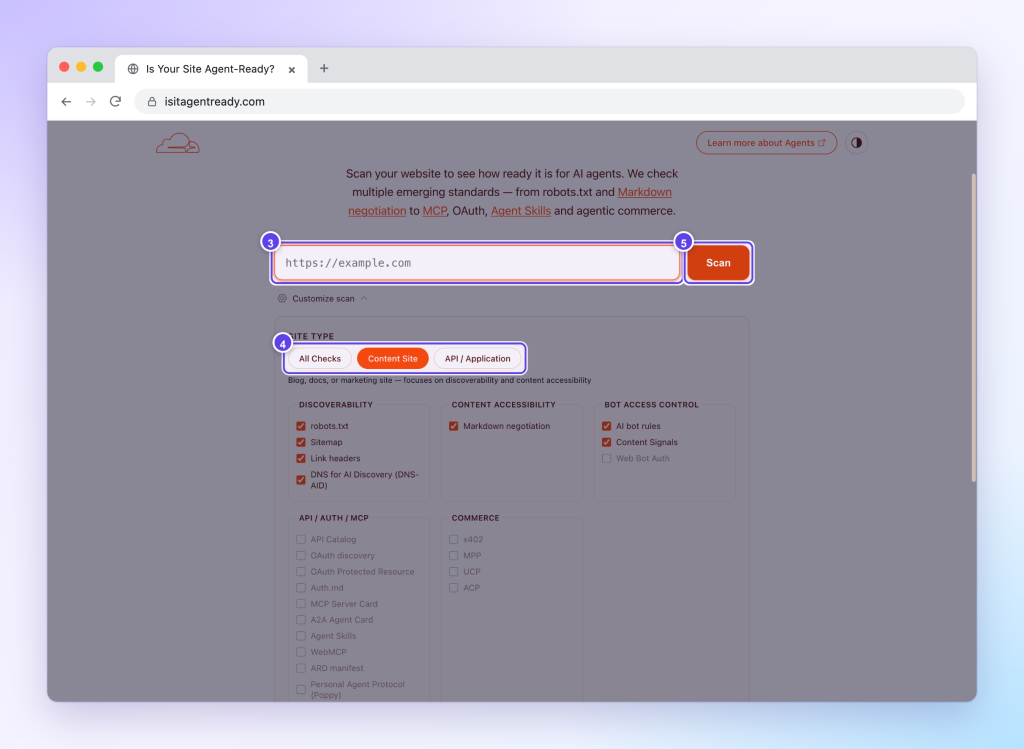
The address field takes the address of the site. The Customize scan link opens the panel with the three site types. Content Site is described on the page as a blog, docs, or marketing site, and it ticks the seven checks listed below. The Scan button starts the scan.
The Content Site type runs seven checks: robots.txt, Sitemap, Link headers, DNS for AI Discovery, Markdown negotiation, AI bot rules, and Content Signals.
Content Site Checks
These seven checks are the ones the scanner runs for a content site. Each section says what the scanner looks at, how to pass it with SureRank, and what to do if it still fails.
robots.txt
- What the scanner checks: That /robots.txt answers with a valid file that contains at least one User-agent line.
- How to pass with SureRank: SureRank builds a robots.txt for the site. To review or change it, go to SureRank → Advanced → Robots.txt Editor. The matching row in AI Ready Checks is Robots.txt Is Readable.
- If it still fails: A real robots.txt file in the root folder of the site replaces the one WordPress builds. Edit or remove that file.
Sitemap
- What the scanner checks: That robots.txt contains a Sitemap: line, and that the address it gives returns a valid XML sitemap.
- How to pass with SureRank: Keep the XML sitemap turned on under SureRank → General → Sitemaps. SureRank adds the Sitemap line to the robots.txt it builds.
- If it still fails: Open the sitemap address in a browser and confirm it loads. A custom robots.txt without a Sitemap line also fails this check, so check the Robots.txt Is Readable row in AI Ready Checks.
Link headers
- What the scanner checks: That the home page sends a Link header that points agents to useful resources, such as the API catalog or a Markdown copy.
- How to pass with SureRank: Turn on Markdown under SureRank → AI Ready → Markdown, which adds the Markdown and sitemap links. Publishing the API catalog adds an api-catalog link. The matching row in AI Ready Checks is Discovery Link Headers.
- If it still fails: A caching plugin or CDN may be serving a copy of the home page from before the change. Clear the cache and scan again.
DNS for AI Discovery
- What the scanner checks: That the domain has records under _agents, such as _index._agents, _a2a._agents, or _mcp._agents.
- How to pass with SureRank: SureRank cannot add DNS records. They are added at the domain registrar or DNS host. The matching row in AI Ready Checks is Agent Discovery in DNS. See How to Add DNS Agent Discovery Records.
- If it still fails: A site without these records does not pass this check. Few sites have them, because the standard is still a draft.
Markdown negotiation
- What the scanner checks: That the site answers a request for Markdown (Accept: text/markdown) with a Markdown page.
- How to pass with SureRank: Go to SureRank → AI Ready → Markdown and turn on Serve a Markdown Copy of Your Pages. The matching row in AI Ready Checks is Markdown for Agents.
- If it still fails: The home page may be left out of Markdown (its content type is not selected under Apply to Post Types, or the page is set to noindex), or a page cache is answering with the stored HTML page. Clear the cache and scan again.
AI bot rules
- What the scanner checks: Whether robots.txt has rules for known AI crawlers. A site with no AI-specific rules still passes, because the wildcard rules apply to every crawler.
- How to pass with SureRank: No change is needed to pass. To allow or block a specific AI crawler, go to SureRank → Advanced → Robots.txt Editor. The matching row in AI Ready Checks is AI Crawler Access, which lists every crawler and whether it is allowed.
- If it still fails: Check that robots.txt does not contain Disallow: / under User-agent: *, because that blocks every crawler.
Content Signals
- What the scanner checks: That robots.txt contains a Content-Signal line.
- How to pass with SureRank: Go to SureRank → AI Ready → Content Signals, turn on Add Content Signals to robots.txt, choose the three options, and click Save. Or click Fix It For Me on the Content Signals row in AI Ready Checks.
- If it still fails: If robots.txt is a real file on the server, SureRank cannot add the line. Add it to that file under User-agent: *. The panel for the row shows the exact line.
Additional Checks for All Checks and API / Application
These checks run for the All Checks and API / Application types. They look for files an AI agent reads to find the tools and sign-in methods of a site. Most are published at addresses under /.well-known/.
If a check shows HTTP 403 for one of these addresses, the server or host is blocking /.well-known/ before WordPress runs. SureRank cannot override that. See How to Fix a 403 on /.well-known/ Addresses.
Each file below has a switch under SureRank → AI Ready → Agent Discovery, or can be turned on with Fix It For Me in AI Ready Checks.
API Catalog
- What the scanner checks: That /.well-known/api-catalog answers with a JSON linkset.
- How to pass with SureRank: Turn on Publish an API Catalog. The matching row is API Catalog.
MCP Server Card
- What the scanner checks: That /.well-known/mcp/server-card.json (or server-cards.json, or mcp.json) describes an MCP server.
- How to pass with SureRank: Install the WordPress MCP Adapter plugin, turn on the MCP server under SureRank → Tools → MCP, and then turn on Publish an MCP Server Card. The card is served only while the MCP server is on. The matching rows are MCP Server and MCP Server Card.
Agent Skills
- What the scanner checks: That /.well-known/agent-skills/index.json lists agent skills.
- How to pass with SureRank: Turn on Publish an Agent Skills Index. The matching row is Agent Skills Index.
WebMCP
- What the scanner checks: That a browser can find tools offered by the page (for example through document.modelContext).
- How to pass with SureRank: Turn on Offer WebMCP Tools. SureRank adds a small inline script that registers two read-only tools. Clear the cache afterward, and do not let an optimization plugin remove inline scripts. The matching row is WebMCP Tools.
ARD manifest
- What the scanner checks: That the site publishes an Agentic Resource Discovery catalog, found through /.well-known/ai-catalog.json or a <link rel=”ai-catalog”> tag in the page head.
- How to pass with SureRank: Turn on Publish an AI Catalog. SureRank adds the catalog link to the page head. The catalog lists only the files that are switched on, so turn on at least one other file first. The matching row is AI Catalog.
Personal Agent Protocol
- What the scanner checks: That /.well-known/poppy.json names the organization and domain of the site.
- How to pass with SureRank: Turn on Publish a Personal Agent Protocol Manifest. Keep the site title set to the name of the organization behind the site. The matching row is Personal Agent Protocol.
Auth.md
- What the scanner checks: That /auth.md explains how an agent registers or signs in.
- How to pass with SureRank: Turn on Publish auth.md. SureRank explains sign-in with WordPress Application Passwords, which WordPress offers on HTTPS sites. The matching row is auth.md.
- If it still fails: The scanner can also look for OAuth Protected Resource metadata when it checks auth.md. SureRank does not publish that metadata, so a result that says it was not found has to be fixed outside SureRank. See the OAuth sections below.
OAuth discovery and OAuth Protected Resource
- What the scanner checks: That the site publishes /.well-known/openid-configuration or /.well-known/oauth-authorization-server, and /.well-known/oauth-protected-resource.
- How to pass with SureRank: SureRank does not publish these files, because WordPress has no OAuth server of its own. The matching row, OAuth Discovery, only detects them.
- If it still fails: A site that does not offer a protected API through OAuth can leave these checks failed. A site that does can install an OAuth server plugin for WordPress, or put an identity provider in front of the site. Once it publishes these files, the row passes.
Web Bot Auth
- What the scanner checks: That /.well-known/http-message-signatures-directory publishes keys.
- How to pass with SureRank: SureRank does not publish these keys. They apply only to a site that runs a bot that signs its requests. The service that runs the bot publishes them. The matching row, Web Bot Auth, only detects them.
Checks SureRank Does Not Cover
The scanner has two more groups of checks that SureRank does not provide:
- Commerce checks (x402, MPP, UCP, and ACP): The scanner marks these as optional. When it finds no shop on the site, it shows them for information only and leaves them out of the result.
- A2A Agent Card: The scanner does not run this check by default. It applies only to a site that runs an A2A agent. The matching row in AI Ready Checks is A2A Agent Card, which only detects the card.
Expected Outcome
After the fixes, clearing the cache, and scanning again, the checks SureRank can publish show as passed. The checks that remain failed are the ones that need a change outside SureRank: DNS records, server access to /.well-known/, an OAuth server, or a bot service.
Notes and Limitations
- The scanner is a separate tool, and its checks follow standards that are still changing. A result can change over time without any change on the site.
- The scanner and AI Ready Checks do not always agree. AI Ready Checks also tests things the scanner does not, such as whether the home page text is readable without JavaScript, and llms.txt.
- Passing these checks shows that a site is easy for AI agents to find and read. It does not decide whether an AI assistant cites the site.
Related Docs
- How to Run AI Ready Checks and Fix the Results in SureRank
- What Each AI Ready Check Means in SureRank
- How to Fix a 403 on /.well-known/ Addresses
- How to Add DNS Agent Discovery Records
FAQ
Which site type should be chosen in the scanner?
Content Site fits a blog, business, or content site. API / Application fits a site that offers a protected API. All Checks runs everything except the A2A Agent Card.
Why does AI bot rules pass when robots.txt has no rules for AI crawlers?
The scanner counts the wildcard rules that apply to every crawler, so a site with no AI-specific rules still passes.
Why does the scanner show checks about shopping?
The commerce checks are optional. When the scanner finds no shop on the site, it shows them for information only and does not count them.
We don't respond to the article feedback, we use it to improve our support content.