
- How to Migrate from Rank Math to SureRank
- How to Migrate from Yoast to SureRank
- How to Migrate from SEOPress to SureRank SEO
- How to Migrate from Squirrly SEO to SureRank
- How to Migrate from All in One SEO (AIOSEO) to SureRank
- How to Migrate from Slim SEO to SureRank
- How to Migrate from The SEO Framework to SureRank
- Migration Failed: How to Diagnose
- After You Migrate: Verification and Cleanup Checklist
- Sitemaps in SureRank
- How to Enable Video Sitemap in SureRank Pro
- How to Enable the News Sitemap in SureRank
- How to Show the HTML Sitemap on Your Site in SureRank Pro
- How to Regenerate the Sitemap After Excluding a Post Type in SureRank
- Change the Sitemap URL in SureRank
- How to Enable Author Sitemap in SureRank
- How to Exclude Post Types from the Sitemap
- How to Enable the Author Sitemap and Why Authors Are Excluded (Pro)
- Editing Meta Box
- SureRank – Page SEO Checks
- Enabling Page SEO Checks in WordPress
- Image Alt Text – Automatic Optimization
- Link Manager
- Using the SureRank Front-End Meta Box
- How to Edit the Meta Title and Description for a Single Page or Post
- Controlling Indexing with Robot Instructions
- How to Set Global Title and Description Templates with Variables
- How to Set a Canonical URL and How the Canonical Field Works
- How to Fix WWW and Non-WWW Version Redirects to Improve Your SEO
- How to Fix: No H1 Heading Found on Your Homepage
- How to Fix Missing H2 Headings on Your Homepage
- Re-run Checks Button in SureRank
- Fix Critical Error: Another SEO Plugin Detected in SureRank
- Fix Warning: Site Tagline Is Not Set in SureRank
- How to Fix: Robots.txt Contains Invalid Rules in SureRank
- How to Fix Multiple SEO Plugins Detected on Your Site
- How to Fix: Homepage is Not Indexable by Search Engines
- Warning: Homepage Does Not Contain Internal Links
- How to Fix: Search Engine Title is Missing on the Page
- Page Level SEO: Broken Links Detected
- How to Fix Missing Alt Text on Images
- How to Fix Page URLs That Are Too Long
- Page Level SEO Warning: No Links Found on This Page
- Page Level SEO Warning: No Images or Videos Found
- Page Level SEO Warning: Missing Search Engine Description
- Page Level SEO Warning: No Subheadings Found on This Page
- Page Level SEO Warning: Canonical Tag is Missing
- Page Level SEO Warning: Open Graph Tags Missing
- What is Google Search Console and how does SureRank use it?
- Recommended Image Sizes
- SureRank – SEO Check Severity Guide
- Using SureRank with Other SEO Plugins – Best Practices
- Import/Export Feature – SureRank Plugin
- What is llms.txt and Does SureRank Support It?
- Does SureRank offer a keyword rank-tracking feature?
- Does SureRank Come With Google Analytics Integration?
- Email Summary in SureRank
- SureRank Role Manager
- Fixing a Fatal Error After Updating SureRank
- SureRank Server Requirements
- Search Engines Not Indexing Your WordPress Site?
- Sitemap Not Showing in SureRank
- Fixing robots.txt Issues in SureRank
- Why a Working Link Is Flagged as Broken (404)
- Which Pages Are Included in Your SureRank Sitemap
- Fixing False SEO Audit Warnings Caused by Caching
- Fixing “Couldn’t Fetch” for Your Sitemap in Google Search Console
- Troubleshooting: Favicon and Logo in Google Search Results (Supported Formats and CDN Gotchas)
- Customize XML Sitemap Top Bar with surerank_sitemap_top_bar_data
- Analyze ACF Field Content with SureRank
- Preserve Modified Date During Updates surerank_freeze_modified_date
- Customize Final Title Tag surerank_final_title
- Customize Post Type Archive Title Output surerank_post_type_archive_title
- Customize Archive Page Title with surerank_archive_title
- Customize the Search Results Page Title surerank_search_title
- Customizing the 404 Page Title surerank_not_found_title
- Customizing the Title Separator surerank_title_separator
- Disable SureRank’s Document Title Integration
- What Is AI Ready in SureRank?
- How to Fix the Indexing and Snippet Rules Result in SureRank AI Ready Checks
- How to Fix the Home Page Text Without JavaScript Result in SureRank AI Ready Checks
- How to Handle the OAuth Discovery Result in SureRank AI Ready Checks
- How to Handle the A2A Agent Card Result in SureRank AI Ready Checks
- How to Handle the Web Bot Auth Result in SureRank AI Ready Checks
- How to Fix the Site Slow and Site Unreachable Results in SureRank AI Ready Checks
- How to Fix the llms.txt Result in SureRank AI Ready Checks
- How to Fix the Content Signals Result in SureRank AI Ready Checks
- How to Fix the MCP Server Card Result in SureRank AI Ready Checks
- How to Fix the Agent Skills Index Result in SureRank AI Ready Checks
- How to Fix the auth.md Result in SureRank AI Ready Checks
- How to Fix the AI Catalog Result in SureRank AI Ready Checks
- How to Fix the Personal Agent Protocol Result in SureRank AI Ready Checks
- What Each AI Ready Check Means in SureRank
- How to Run AI Ready Checks and Fix the Results in SureRank
- How to Set Content Signals in SureRank
- How to Publish Agent Discovery Files in SureRank
- How to Fix a 403 on /.well-known/ Addresses
- How to Add DNS Agent Discovery Records
- Troubleshooting: Markdown, Link Header, or WebMCP Not Showing in AI Ready Checks
- How to Improve Your isitagentready.com Result With SureRank
How to Fix the auth.md Result in SureRank AI Ready Checks
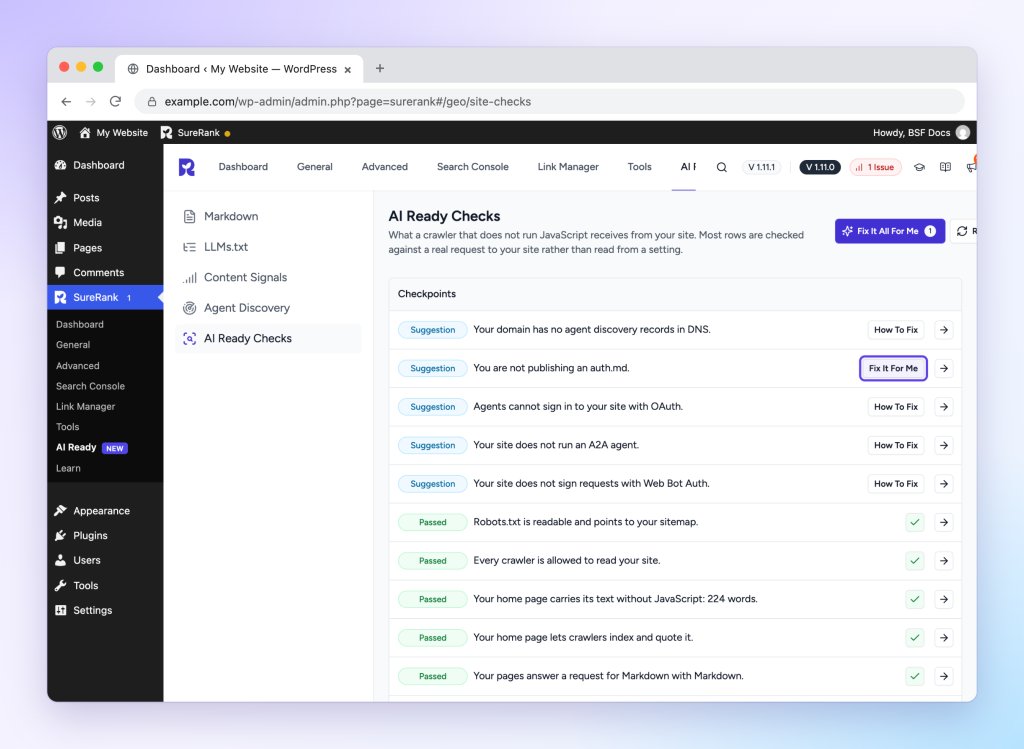
The auth.md check in SureRank tests whether the site publishes a file at /auth.md that tells an AI agent how to sign in to the site. On WordPress, that means signing in with an Application Password. This guide explains each message the check can show, and how to fix it.
Requirements
- SureRank and SureRank Premium, both active and updated to the latest versions
- An active SureRank Premium license (Pro, Starter, or Business). Upgrade here
- AI Ready turned on. See What Is AI Ready in SureRank?.
What the Check Looks At
SureRank first checks whether WordPress offers Application Passwords on the site. WordPress offers them on sites that use HTTPS, and a plugin can turn them off. If they are not available, there is nothing true for auth.md to describe, so the file is not published.
If Application Passwords are available and the Publish auth.md switch is on, SureRank requests https://example.com/auth.md, with your own domain in place of example.com. It checks that it gets a plain text file that begins with a heading that mentions auth.md.
The row shows Passed and reads “Your auth.md is being served.” when the file is published and usable. The row is shown only for a site at the root of a domain.
Before You Begin
If you’re looking to see which message the site shows, follow the steps below.
- Go to SureRank → AI Ready → AI Ready Checks.
- Find the row that begins with “Agents have no way to sign in to your site”, “You are not publishing an auth.md”, “Your auth.md is not reaching SureRank”, or “Something else is answering at /auth.md.”
- Click Fix It For Me on the row. If the row shows Help Me Fix instead, follow the steps in this guide.
How to Find Out What Answers an Address
If a row says that something else is answering an address, or that the address is not reaching SureRank, find out what the server sends back first. Follow the steps below. The same details help the developer or the host.
- Open the address from the row in a private browser window, with your own domain in place of example.com.
- Look at what loads. A normal web page, a server error page, and a text or JSON file each point to a different cause.
- To see the status number, open the browser developer tools (right-click the page and choose Inspect), go to the Network tab, reload the page, and click the first request. Note the Status and the Content-Type.
- Write down the exact address, the status number, the Content-Type, and the message on the row.
When you ask the developer or the host for a change, send these four details. They are needed to find which rule answers the address.
Common Issues
This section lists each message and what to do about it. After each fix, click Run Checks to test again.
Issue: “Agents have no way to sign in to your site.”
Symptom: The row shows a Suggestion and no Fix It For Me button. The panel explains that Application Passwords are switched off.
Cause: WordPress does not offer Application Passwords on the site. Either the site is not on HTTPS, or a plugin turned them off.
Fix:
- Make sure the site is served over HTTPS.
- If the site is on HTTPS, check whether a security plugin turns off Application Passwords, and allow them if the site should let agents sign in. For example, Wordfence turns them off by default, and its option for this is called Disable WordPress application passwords. Turn that option off in the plugin if the site should let agents sign in.
- Click Run Checks.
Expected outcome: The row changes to “You are not publishing an auth.md.” or to Passed, depending on the switch.
If the site should not let agents sign in, there is nothing to fix. The row stays a Suggestion.
Issue: “You are not publishing an auth.md.”
Symptom: The row shows a Suggestion with a Fix It For Me button.
Cause: The Publish auth.md switch is off, so the file does not exist.
Fix:
- Click Fix It For Me on the row. Or go to SureRank → AI Ready → Agent Discovery, turn on Publish auth.md, and click Save.
- Wait for the message “auth.md turned on.”
- Click Run Checks.
Expected outcome: The row no longer shows this message. If nothing else is found, it shows Passed and reads “Your auth.md is being served.”
Issue: “Your auth.md is not reaching SureRank.”
Symptom: The row shows a Warning, even though the switch is on. The panel says SureRank is publishing the file, and gives one of these reasons:
- The permalinks are set to Plain, so the server answers the address before WordPress sees it.
- The address answers with an error. A security plugin or a server rule may be blocking it.
Cause: The server, or a security plugin, answers /auth.md before WordPress runs.
Fix:
- If the panel says the permalinks are Plain, first ask the developer or the host to check the redirects and to take a backup, because changing the permalink structure changes the address of every post and page, and old links can stop working. Then go to Settings → Permalinks, choose any other structure, and click Save Changes.
- Otherwise, check the settings of any security plugin and the rules of the server, and allow /auth.md.
- Open https://example.com/auth.md in a browser, with your own domain, to see what answers.
- Click Run Checks.
Expected outcome: The row no longer shows this message. If nothing else is found, it shows Passed.
Issue: “Something else is answering at /auth.md.”
Symptom: The row shows a Warning.
Cause: The address returns a page, or a file that is not the auth.md that SureRank writes. Another plugin, or a catch-all route in the theme, answers the address first.
Fix:
- Open https://example.com/auth.md in a browser, with your own domain. If you see a normal web page, something else is answering.
- Find the plugin or theme rule that answers every unknown address with a page, and turn it off or make an exception for /auth.md.
- Click Run Checks.
Expected outcome: The row no longer shows this message. If nothing else is found, it shows Passed.
Issue: The row is not shown
Symptom: The auth.md row is not in the list.
Cause: The site is installed in a subdirectory. auth.md counts only at the root of a domain, so SureRank does not test it there.
Fix: Publish the file at the root of the domain with whatever serves it.
Expected outcome: There is nothing to fix inside SureRank for a subdirectory site.
Still Not Resolved?
If the steps above do not help, contact the SureRank support team with the following details:
- WordPress version
- SureRank and SureRank Pro versions
- The exact message on the row in AI Ready Checks
- Whether the site uses HTTPS
- What you see when you open https://example.com/auth.md in a browser. Replace example.com with your domain.
Notes
- Application Passwords are issued by a user and can be revoked at any time. It is recommended to give an agent its own user account with the least access the task needs.
- Some security plugins limit which users can create an Application Password, instead of turning them off for the whole site. The auth.md row checks only whether the site offers them, so the row can show Passed while the user of an agent still cannot create one. If an agent cannot sign in, check the settings of the security plugin for that user.
- Unlike the other discovery files, auth.md is at the root of the site and not under /.well-known/.
- Most rows in AI Ready Checks test a real request, so a cache can change the result. Clear the cache before running the checks again.
Related Docs
We don't respond to the article feedback, we use it to improve our support content.